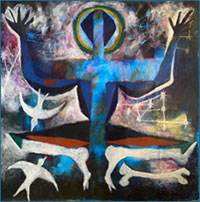
This article introduces Gautam Jhanjee, an artist whose works provide a multifaith perspective. It focuses on pieces from his series “Four Theological Paintings: A Liturgical Cycle of Death, Resurrection, and Transfiguration” which draws heavily from Christian imagery and ideas. One work from this series, “Christ of the Third Millenium” is shown adjacent. Jhanjee’s ideas do not necessarily align with Catholic teaching, but they can be seen as one way of understanding the “universality of God’s saving plan”[1].
Jhanjee is the progeny of various cultures and faiths. Born in India to a father of German and Indian heritage and Maharashtrian mother, he has lived in Oman, the UK and Australia. His father is Catholic and mother, Hindu. Before visual art, Jhanjee worked as an architect. It is this rich background from which his work emerges.
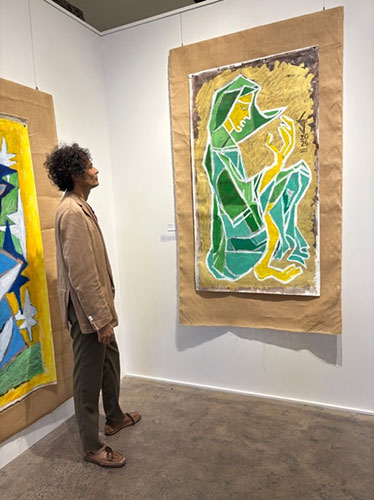
While he does not publicly declare a specific religion, several aspects of his upbringing and philosophy provide context and insights into his work. He draws deeply on mythology, spirituality, and symbolic archetypes—particularly those of the feminine divine. This was especially reflected in a recent exhibition, “Goddess with a Thousand Faces”.
Given his family background, it seems no coincidence therefore, that his cousin on his father’s side is Sameer Vikram Advani, LC, a Catholic priest and Professor of Theology in Rome. He authored several books on religious pluralism and most recently ‘Ratzinger on Religious Pluralism’[2]. Indeed, Jhanjee’s work seems to provide a visual answer to some of the questions Advani discusses in his book: What can Christian theology claim about the place of other religions in God’s providential plan for humanity? How can it reconcile the universality of God’s saving plan and the particularity of Christ and the Church? What meaning is left to Christian existence and mission in a religiously pluralist world?
In 2015, Jhanjee decided that his career in architecture had run its course, saying “I’d reached a level of fulfillment with it”. At that point, he knew he really wanted to be a painter. So, he took the opportunity when he moved to Australia in 2017 to make a clean break. He closed his practice and after a short six-month stint in Brisbane, moved to Canberra where he just started painting.
Since beginning his artistic journey, he has been interested in sacred themes of East and West. The cultural diversity of his upbringing had a profound impact on the young Jhanjee, having attended Mass with his father at Mount Mary’s Church in Bombay and later Brentwood Cathedral in the UK. The sermons and ideas he was exposed to were to have a strong influence on his artistic endeavours as did the beliefs and practices of his mother’s faith, Hinduism. Perhaps at this time, Jhanjee was forming ideas of if and how these two faiths align.
It was from his bi-cultural and bi-faith upbringing that Jhanjee developed an interest in the universal principles of all the world’s great religions. “What I try to do with my work is look at what’s archetypal and universal”[3]. In his current body of work, he focuses on eschatological themes as he perceives them expressed in Christianity, such as resurrection. He says of this work; “I take some of the biggest symbols of Christianity and mankind, like the Annunciation, and try and give them a contemporary, perhaps you’d say, revivification. So, a kind of reinterpretation or a reenergizing of ancient religious images”[4]. In so doing, he draws from both Christian and non-Christian symbolism to express his ideas.
He talks of his ideas coming from the unconscious and whatever is the spirit of one’s time. It is for him a recording of cultural and civilizational memory. His tools for doing so are the formal language of art: depicting planes in space, depth of voids and, flattening parts of an image and creating dynamism with form. In fact, one of his greatest influences has been Cubism as expressed by artists such as Pablo Picasso and George Braque. What inspired him was how they fragmented objects and reconstructed them. He regards this fragmentation as a reflection of the secularization of society. He says of his work that he’s taking these fragments and “putting them back together again to create meaning and as a counterpoint to the secular, to re enchant the world.”[5]
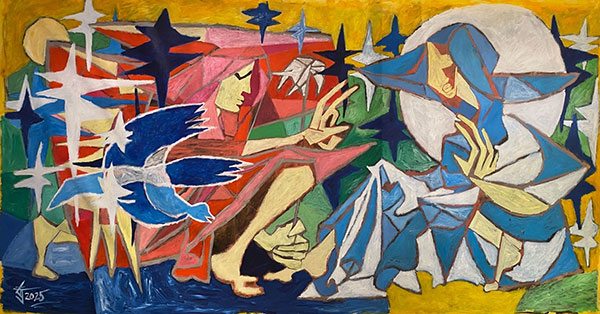
The first of the series “Four Theological Paintings: A Liturgical Cycle of Death, Resurrection, and Transfiguration” is The Annunciation in a Field of Stars: Gabriel’s message under the cosmic order. Representing the moment of incarnation when “The Word became flesh” (John 1:14), we readily recognise the subject with Mary depicted in a receptive state and Gabriel dynamically delivering the divine message. Drawing, as it does, from classical forms as represented by the works of Leonardo da Vinci, Botticelli, Fra Angelico and Fra Filippo Lippi, the work provides a familiar reference point for the cycle.
In this piece we see Jhanjee’s first reference to the stars. This appears to provide a modern context at a time when mankind is looking to outer space for its future existence. Jhanjee seems to blend religious and scientific hopes by placing the figures of Gabriel and Mary in a “living field of stars”, overlapping each other to depict the “numinous bursting forth into the mundane”[6]. The use of stars could also hark back to Jhanjee’s Hindu influences where they can represent divine light. It is notable also that he has painted Gabriel as “fiery red”, which in the Hindu faith can represent fertility, yet for Christians it often represents Jesus’ blood and sacrifice. I find this a most interesting application given Gabriel’s message is one of incarnation while we know the story’s completion and point of glory is achieved through bloodshed.
In the overlapping of forms, we see the influence of Cubism. The figures and symbols are overlaid in a manner which the artist refers to as reconstruction. The Cubist style and diverse symbolism give the piece a contemporary feel and thus brings an ancient Christian message to modern times in a way that could open it up to a religiously pluralist world.
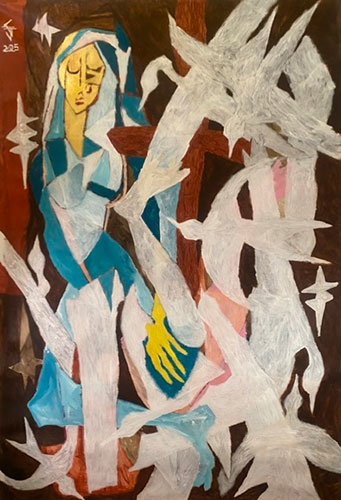
The second work in the series is called The Second Day: Madonna Between Loss and Revelation. This depicts Mary at a time between the crucifixion and before Christ’s resurrection.
Here, Jhanjee is trying to capture what he refers to as the “poignancy” of what the Madonna would have experienced between Jesus’ death and His rising on the third day. “There’s closed eyes … there’s a sense of immersion in a kind of changing world because it’s liminal, that state”[7]. He features birds as a symbol of peace. We can also feel in it a sense of hope in what we know is to come.
The choice and placement of symbols achieve a sense of anticipation and uncertainty. Instead of doves, which traditionally represent the Holy Spirit, he has used swallows. Perhaps this is because their shape gives the work a kind of dynamism. The cross in the centre, not only provides context to the unfolding drama, but is a symbol by which the artist describes what he calls her “in-between state”.
We also see a fragmentation of form to evoke a sense of her being “taken apart and not quite being put together again”. It is unclear if he sees Mary as ever being put to rights again, but perhaps this is implied by the completion of the cycle with Christ’s rising.
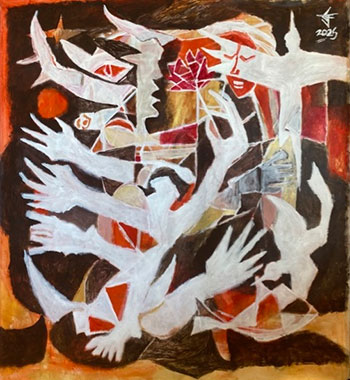
The next painting in the series is called The Third Day (Resurrection). It is an abstract work seeking to depict a scene all too familiar to us on Good Friday. The meaning is not immediately obvious, but if we take a closer look, the symbols can unlock the intent.
We can see in the lower right the shape of a fish – Ichthys, depicting Christ. There is also a curious arrangement of white arms and hands – all of which appear to embody a potential energy to later arise from a dormant state. This is all directed by a bird in the upper right with it wings, in the shape of a cruciform. It covers the face of a figure – the Madonna – who is both asleep and sad – which for Jhanjee symbolises death.
It is not just the subject matter and arrangement of forms that challenges the viewer. The traditional symbol of the Holy Spirit is again replaced with the swallow and the white lily by the lotus. These are interesting interpretations of Christian symbols and evidence of the artist’s multicultural background. In my view, this interweaving of symbols from two different cultures provide a pathway into the story for those of other faiths or none.
It is interesting that Jhanjee has included a symbol of significance in Indian mythology in this work – the lotus flower. Painted in full bloom, Jhanjee says it represents a return to life “because lotus flowers grow in the murky depths of stagnant water … and something beautiful comes out of the darkness”. And thus, he wanted to take this familiar image and in the spirit of renewal, give it life for today.
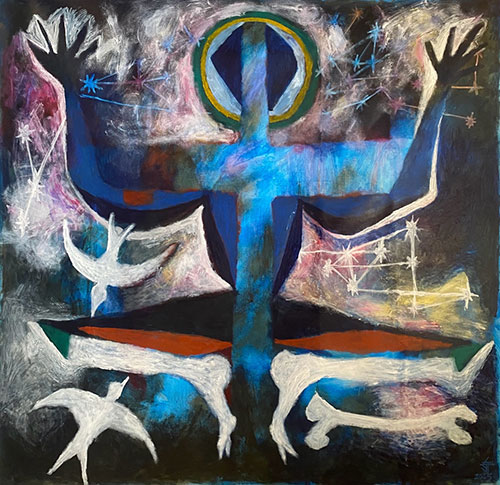
The fourth and final piece in the series is Christ of the Third Millennium. With this work, Jhanjee depicts the Christ who came into the world two thousand years ago and is now taking us into a third millennia and beyond. It is notable that he speaks of “endless voids” in this work, having been inspired by “astronomy photography of stars and nebulae and galaxies far away and constellations”. He says of this that he’s trying to show that very long-distance trajectory of time, which I think is a very interesting amalgam of religion and science in an era when we are looking to space for the future of humanity.
He says of the work that he was inspired by Byzantine iconography of Christ. If we consider the traditional depiction of Christ as Pantocrator, He is seated on a throne as ruler of all. Jhanjee has Christ seated with crossed legs as we might see the Hindu god, Brahma or even The Buddha. The most obvious reference to Christ is the cruciform within his body and the raised arms, a gesture of resurrection. An interesting inclusion is a bone to “ground the painting” but perhaps this could also represent the death over which Christ triumphs. The apparent reference to other faiths is clearly informed by his desire to express the archetypal and universal. To this end, it could be said that it is part of the artist’s effort to reconcile the universality of God’s saving plan.
The mixture of cultural references, composition, colour and scale of the work make it a powerful end to the series. Starting with the cosmic backdrop of The Annunciation in a Field of Stars, Christ of the Third Millennium, it takes us back into space through “endless voids” and gives us a view of eternity. Indeed, this work could help to give to others a meaning to Christian existence and mission.
I found Gautam Jhanjee’s work impactful and thought provoking. Presenting his work on this website invites viewers to contemplate symbolism drawn from a broad range of worldviews and beliefs present in our pluralist society, and to consider them from a Catholic perspective. The artistic merit of his work also injects a gravitas to universal themes of life and death and opens these ideas to a broader audience. Indeed, each piece in the “Four Theological Paintings: A Liturgical Cycle of Death, Resurrection, and Transfiguration” series could easily find a place in any religious context whether Christian or Hindu (to name just two from Jhanjee’s upbringing). In this sense, his work could provide a visual pathway into the field of enquiry posed by his cousin Fr Sameer to explore what meaning is left to Christian existence and mission in a religiously pluralist world.
Irene Sutherland
November 2025
*Editor’s Note: This article is a biographical piece on the artist Gautam Jhanjee. It is not a piece of theological writing.
LITURGICAL PORTFOLIO – GAUTAM JHANJEE (PDF)
[1] Reference to Ratzinger on Religious Pluralism by Jhanjee’s cousin, Fr Sameer Avani on the Emmaus Academic website.
[3] From an interview with the artist in September 2025
[4] Ibid
[5] Ibid
[6] From an interview with the artist in September 2025
[7] Ibid